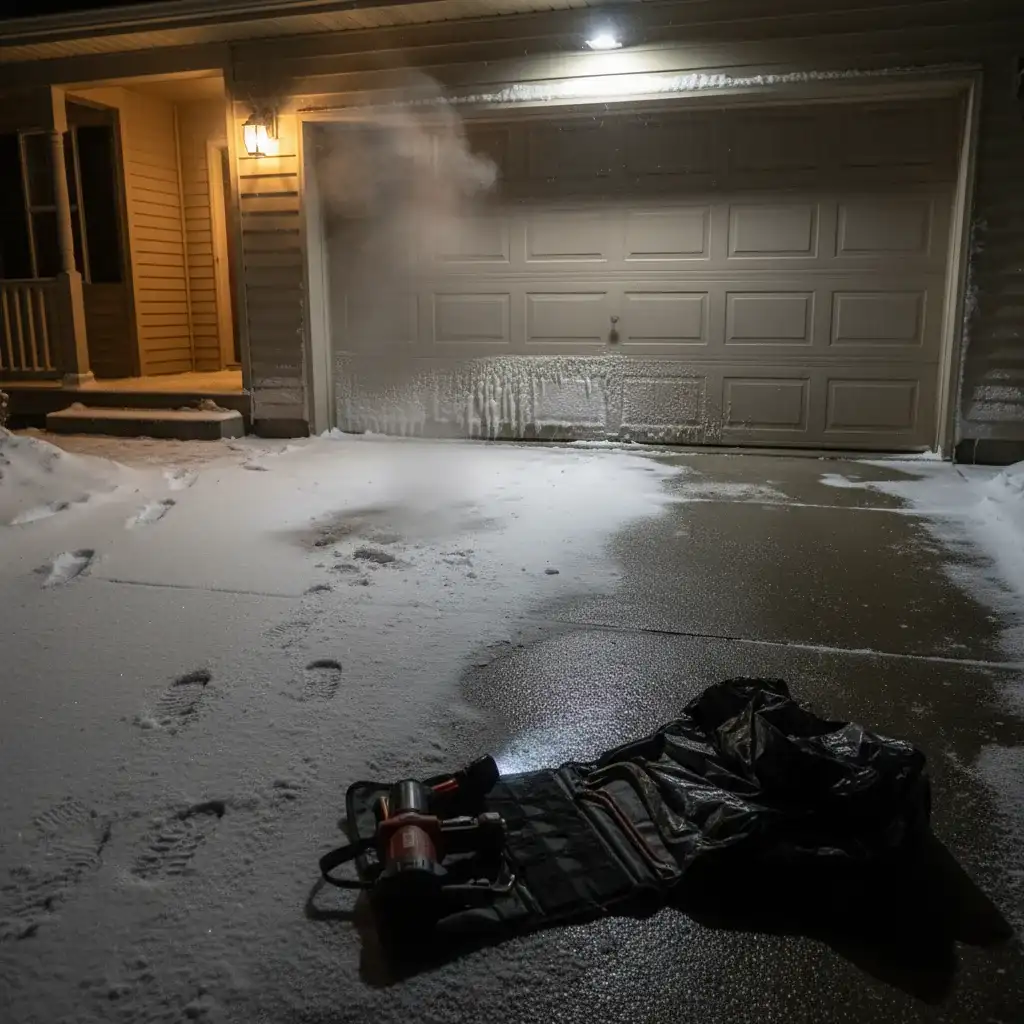
You press close. The door starts down, thinks better of it, and heads back up. Most of the time the culprit is one of the two little safety eyes at the bottom of the tracks. Many of these fixes are small.
In short: When the door bounces back up before it touches the floor, or only closes while you lean on the wall button, suspect the safety eyes. Start by clearing the floor between the eyes and wiping the lenses. If the small lights on the eyes still are not steady, the aim, the wire, or the eye itself needs work. We price the fix on site before we start.
One eye sits low on each side of the door, a few inches off the floor. One sends an invisible beam of light across the opening. The other receives it. While the door is closing, the opener watches that beam. If anything breaks it, even for a moment, the opener stops and sends the door back up. The eyes stop the door before it comes down on a kid, a dog, or a car hood.
Federal safety rules have required this kind of protection on home garage door openers since 1993. Openers older than that may have no eyes at all. If yours is one of them, read our opener repair page about when to replace it.
| Cause | What you notice | Fix |
|---|---|---|
| Something in the beam | Door reverses at the same spot each time | Move the object. Salt bags, boots, and snow piles are common. |
| Eyes knocked out of line | Receiving light off or flickering | Re-aim the bracket and tighten it. |
| Dirty or fogged lens | Works some days, fails on others | Clean the lenses. |
| Low sun in the lens | Fails at the same time of day | Swap sides or shade the receiving eye. |
| Damaged wire | Both lights dark, or lights blink on and off | Find the break, then splice or rerun the wire. |
| Failed eye | One light dead even with good wire and aim | Replace with an eye made for your opener. |
For a slower walk through the aim, see our photo-eye alignment guide. If the door refuses to close for some other reason, a door that won't close covers the rest of the list.
First we find out which part is at fault. We check power at the opener's sensor terminals, test the wire end to end, and look at both eyes and their brackets. Guessing wastes your money, since a new pair of eyes will not help a broken wire.
Bent brackets get straightened or replaced, and we lock the eyes in line so a light bump will not knock them out. Damaged wire gets spliced, or rerun if it has been chewed in several spots. A dead eye gets replaced with one made for your brand of opener. We finish by closing the door onto an object in the beam to confirm it reverses, and we test the separate contact reverse with a board on the floor.
Once in a while both eyes test good and the fault sits in the opener's circuit board. We explain that before going further.
Some people tape the eyes together, point them at each other up near the ceiling, or jumper the terminals to make the problem go away. The door closes again. It also stops reversing for anything shorter than the new beam height, which means kids and pets. We do not do it, and we would ask you not to either.
The eyes sit right where the snow lands. It falls off the car, melts, and refreezes in the corner by the track. A small ridge of ice can block the beam or push a bracket out of line. Salt spray dries into a white film on the lens. If your door started reversing after a snowstorm, clear and dry the floor around both eyes before you do anything else. The same slush can glue the rubber seal to the concrete, and the opener reverses for that reason too. Our frozen door post covers that one.
We fix sensors across Dane County, including Madison, Middleton, Fitchburg, Verona, and Sun Prairie.
Call or text and tell us the brand of opener. A short video of the door reversing, plus a photo of each eye with its light, tells us a lot before we arrive. The estimate is free, and you hear the price before any work begins. When parts are on hand, same-day repair is often possible.
Sunlight is a likely cause. When the sun sits low and shines straight into the garage, it can wash out the receiving eye so it cannot see the beam. If the trouble lines up with a time of day, moving the receiving eye to the side of the door that stays shaded often ends it.
Sensors are tied to the opener maker, and sometimes to its age. Read the label on the opener's motor housing first, then buy eyes listed for that maker and model. A mismatched pair will never light up.
Not always the eye. On many openers, the sending eye glows when it has power, and the receiving eye glows when it sees the beam. If both are dark, the wire or the opener's sensor terminals are the more likely problem. If only the receiving light is off, aim and dirt are the first things to check.
It works as a stopgap. On most openers, holding the button down overrides the eyes and drives the door closed. Watch it all the way down and keep the path clear, because the eyes are not protecting anyone while you do it. Get them fixed soon.
They do. The thin low-voltage wire runs along the wall where mice travel, and they gnaw through it. A break in the wire looks exactly like a failed sensor, which is why we test the wire before replacing anything.