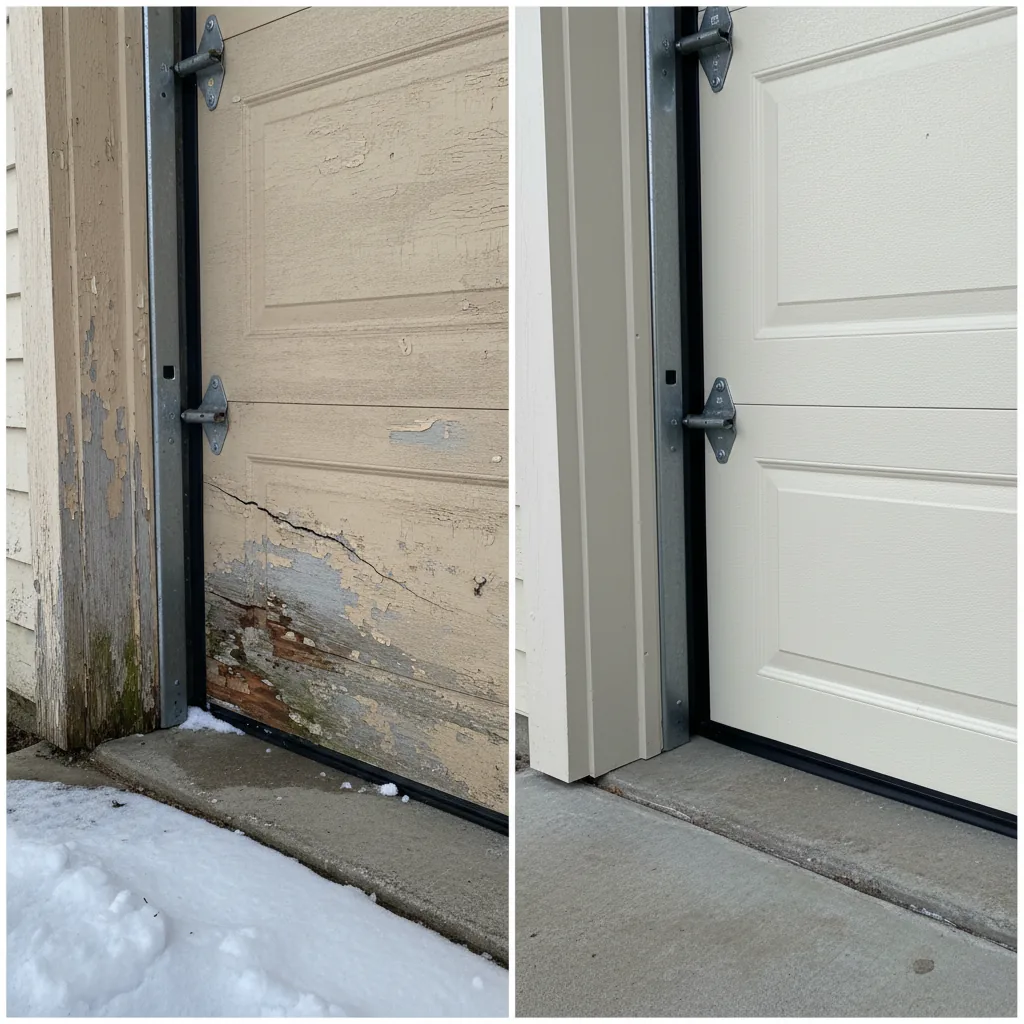
Someone backed into the door. Or the bottom section has rusted through after too many winters of slush. Most of the time you can replace the damaged section and keep the rest of the door.
In short: If the maker still builds your door, a damaged section can usually be swapped on its own. Around Madison, one new section usually costs $320 to $620, based on the style and insulation. Swapping the bottom two sections of a 16-foot door usually costs $480 to $880. These are reference ranges. We confirm the price once we know your door's make and model.
Not every mark on a door needs a new panel. The type of damage tells us what the fix should be.
| Damage | Usual fix | Why |
|---|---|---|
| Shallow dent, no crease | Often left alone, or eased back | Mostly a looks problem. The section still works the way it should. |
| Creased or folded steel | Replace the section | A fold weakens the section and can split as the door rolls over the curve. |
| Rust along the bottom edge | Replace the bottom section | Salt and slush sit against the bottom edge all winter. Rust spreads under the paint. |
| Cracked end stile or loose hinge | Repair the stile, or replace the section | The hinges bolt into the ends of each section. A torn stile cannot hold them. |
| Rotted or split wood | Replace the section, or the whole door | Wood doors that stay wet at the bottom rot from the inside first. |
| Top section bowed by the opener | Add a reinforcing strut, replace if bent | The opener pulls on the top section. Without a strut, the steel can bow over time. |
A sectional door is a stack of horizontal sections joined by hinges. Each one can come off and go back on. That is why a single dented section rarely means a whole new door. Still, there are times when a new door is the better buy:
If you land in that camp, our new door installation page explains how we measure and what the options are. For a closer look at the dollars on either path, see panel replacement cost.
Matching starts with the label. Most doors carry a sticker on the inside edge of a section with the maker and the model. We also measure the section height and the door width, note the panel design, and check the color and texture. Then we order the section from the maker.
Insulation has to match too. Some doors have foam boards slid into the back of each section. Others have polyurethane foam injected between two steel skins, which bonds everything into a stiffer panel. A section built one way will not line up with sections built the other way. We check which kind you have before we order.
How long the part takes depends on the maker and the style. We tell you when we place the order and call you when it arrives.
Doors from a few decades back are the hardest case. Makers retire designs, and once the stock is gone, there is no new section to buy. A used section in the same style can sometimes work, but finding one is luck. When no match is out there, we lay out what a new door would cost so you can weigh it against living with the damage.
Madison driveways get salted all winter. The car brings that salt into the garage, the snow melts, and brine puddles right against the bottom of the door. Steel sections rust from the bottom edge up, often under paint that still looks fine. Wood doors soak up the same water and rot. A good bottom seal and a quick rinse of the door bottom in spring slow this down. Our bottom seal and gap repair page covers the seal side of it.
Panel jobs take us across Madison and out to Middleton, Verona, Fitchburg, and Sun Prairie.
Send a picture of the damage from outside, a photo of the inside of the door, and a close shot of any maker sticker you can find. That is often enough to tell whether a matching section exists. We visit to measure and confirm before ordering. The estimate is free. If a car caused the damage, we can put the estimate in writing for your insurance company.
A shallow dent with no crease can sometimes be eased back, and some people simply live with it. A crease is different. Once the steel folds, the section loses strength along that line and can buckle when the door bends over the top of the track. Creased sections are usually replaced.
When the maker still builds your model, the new section comes from them in the same style and color family. Paint on the old sections fades with sun, so a brand new section can look a shade brighter at first. On a door with an older finish, painting the whole door afterward gives the best match.
Look for a sticker on the inside edge of a section, often near a hinge or on the end stile. It may list the maker, the model, and a date. Take a photo of it and send it along when you contact us. It saves a lot of guessing.
A small dent is fine. A cracked or folded section is a risk, since it can split further as the door rolls over the curve of the track. If a section is bent, keep the door closed until it is looked at.
Yes. We work on most brands. Whether a section is still made for your door is the main question, and the sticker usually answers it.