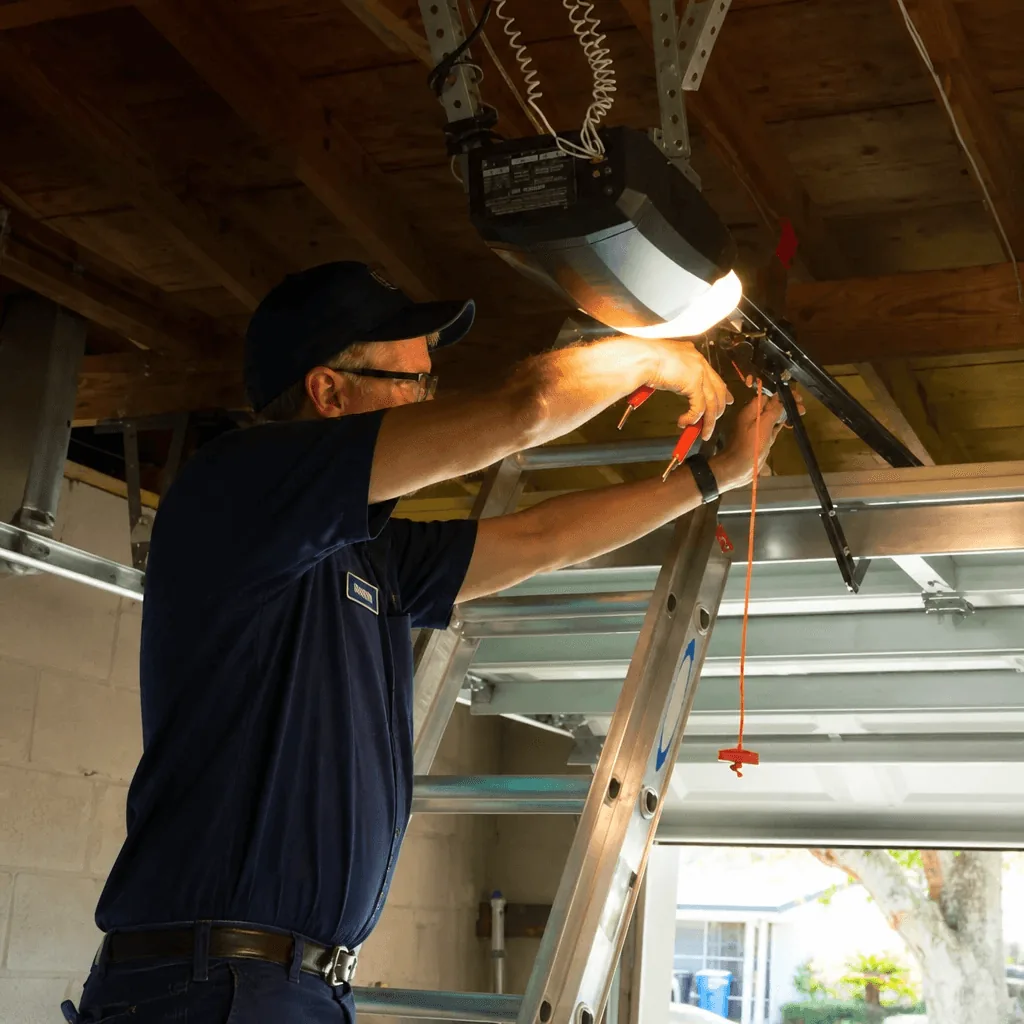
You are standing in the driveway in the cold, punching in the code, and the door does nothing. Or the remote clicks and the door waits until you are ten feet away. These problems are usually small, and we can sort them out.
In short: If the wall button inside still runs the door, the motor is fine, and the trouble is usually the keypad, the remote, or the opener's radio receiver. Start with a fresh battery and the lock setting on the wall control. If nothing runs the door, including the wall button, the opener itself needs a look.
| What happens | Likely reason | First step |
|---|---|---|
| Remote dead, wall button fine | Battery, or the lock setting on the wall control | New battery, then check for a lock light on the wall control. |
| Remote works only up close | Weak battery, a tucked-up antenna, or radio noise from an LED bulb | Let the antenna hang straight down. Try a different bulb. |
| Keypad lights up, door ignores it | Pairing lost, or the code changed | Re-pair the keypad to the opener. |
| Keypad dark, no beep | Dead battery, or corrosion from moisture inside the case | Open the cover and check for green or white crust on the contacts. |
| Nothing works, including the wall button | The opener or its power | This is an opener problem. See our opener repair page. |
If the wall button fails too, head to opener repair. The keypad and remotes cannot fix an opener that is not running.
Outside keypads sit in rain and cold all year. Cold drains its battery faster, so a keypad that worked all fall can go dim in January. Moisture sneaks under the cover, and over time it leaves a green or white crust on the battery contacts. Keys wear, too. After a few years of the same four numbers, the rubber on those keys can stop making contact.
A fresh battery and a cleaned contact bring many keypads back. When the circuit board inside has corroded, a new keypad is the better fix. We match it to your opener brand so it pairs cleanly.
Every opener has a learn button, usually on the back or side of the motor unit, sometimes under the light cover. Pressing it puts the opener in listening mode for a short window. During that window, you press the button on the remote or enter a code on the keypad, and the opener remembers it. Each opener can hold only so many remotes and keypads, so an old unused remote can take a spot.
The steps differ by brand and by age. Our post on reprogramming a remote walks through the usual steps. If the opener refuses to learn anything at all, the receiver on its logic board may have failed.
Openers from different decades use different kinds of signals. Older units used a fixed code set with small switches. Later units moved to rolling codes that change each time you press the button, which is much harder for anyone to copy. A remote built for one kind will not work with another. If your opener is old enough that new remotes for it are hard to find, it may be time to think about a new opener. We install LiftMaster, and a new unit comes ready for current remotes and keypads.
Keypad and remote calls come to us from Madison, Sun Prairie, Verona, Middleton, and Fitchburg.
Put a fresh battery in the remote or keypad, check the wall control for a lock light, and try pairing once with your opener's manual. If none of that works, call or text with the brand of opener and a photo of the learn button. The estimate is free, and you hear the price before we touch anything.
Clear the opener's memory, then pair the remotes you still have. On most openers, pressing and holding the learn button until the small light beside it goes dark erases every remote and keypad. Then you pair each one again. The lost remote stops working the moment the memory is cleared.
Often, yes, if the package lists your opener's brand and the kind of signal it uses. Openers from different eras use different signals. Look for the color of the learn button on the motor unit, since many brands use it to mark the signal type, and match it on the remote's box.
A weak battery is the first thing to rule out. After that, look at the thin antenna wire that dangles from the opener. If it got tucked up or cut short, range drops. Certain LED bulbs screwed into the opener can also give off radio noise that cuts range.
The keypad is getting power but the opener is not listening to it. The pairing may have been lost, the opener's lock setting may be on, or the keypad's code may have changed. Re-pairing it fixes most of these.
Yes. We can pair most built-in car buttons while we are there. Some newer openers need a small bridge part to talk to older car systems, and we will tell you if yours does.